
In the contemporary social and business context, the materialization of identity through physical objects has become an indispensable element of community building. The phenomenon known as branded merchandise has transcended its original function as a simple marketing tool and transformed into a key mechanism for establishing emotional connection, signaling belonging, and communicating deep organizational values. Within specific microsystems, such as university campuses and fast-growing startups, branded merchandise serves as a tangible anchor in a sea of digital information, providing a sense of stability and identity in environments characterized by a high rate of change and innovation.
Blue Frame, an agency specializing in premium personalized promotional merchandise, has recognized this trend, emphasizing that branded merchandise must be of high quality to truly fulfill its purpose—to be worn and used daily, not just serve as a fleeting visual stimulus on social media. In this report, we will analyze in detail how strategically designed branded merchandise impacts the dynamics of student life and the evolution of startup culture, drawing on sociological theories, practical examples, and upcoming trends for 2025.
The Psychological Power of Identification Through Branded Merch
To understand why branded merch has such a powerful impact on the student and startup populations, we must turn to social identity theory. According to this theory, individuals strive for belonging to groups that provide them with a positive sense of self-esteem and distinction from others. Branded merch here serves as a visual symbol of that belonging. When a student wears a hoodie with their club's logo or a startup employee uses a thermos with their company's visual identity, they aren't just wearing a logo; they're wearing an entire narrative about who they are and what they aspire to.
Clothing and accessories function as "costumes" in the daily performance of our professional and social roles. In a business setting, premium clothing signals competence and status, while in more relaxed yet ambitious environments like startups, branded merchandise in the form of stylish sweatshirts or tech gadgets signals innovation and team cohesion.
Impact on Loyalty and Value Perception
Marketing research indicates that branded merchandise directly impacts loyalty through the mechanisms of trust, satisfaction, and perceived value. If the item an individual receives (whether as a gift or a purchase) is high-quality, that quality is subconsciously transferred to the organization itself. Conversely, low-quality branded merchandise can have the opposite effect, suggesting that the organization does not value its members or employees enough to provide them with a durable and useful product.
| The Psychological Dimension | How Merch Works | Outcome for the organization |
| Self-definition | The individual uses the brand to communicate their own identity. | Strong brand connection and advocacy. |
| Social cohesion | Visual uniformity reduces hierarchical barriers. | Improved team collaboration and a sense of community. |
| Reciprocity | Receiving a quality gift package fosters a sense of obligation and gratitude. | Increased motivation and engagement of members/employees. |
Application in the academic community: How branded merchandise builds student spirit
College is a period of intense identity and belonging. Colleges and student associations use branded merchandise to build a strong base of loyal followers. In Croatia, examples like the eSTUDENT association show how T-shirts and hoodies with creative designs can create a recognizable brand that attracts the most active students.
The Welcome Pack for Freshmen as a Tool for Easier Integration
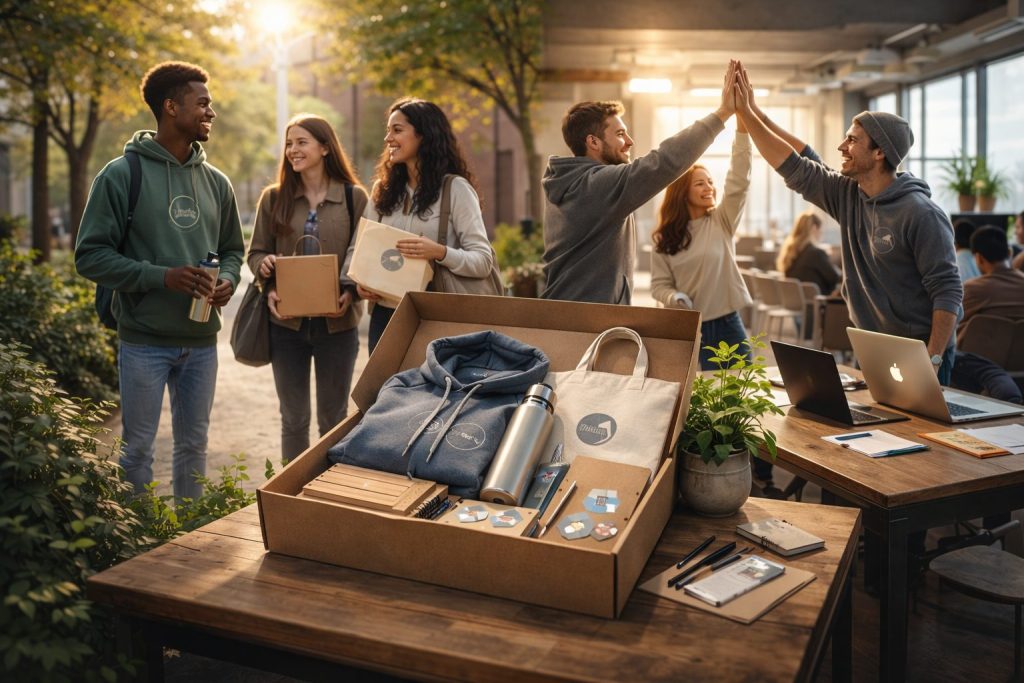
A student's first encounter with the university is often filled with stress and uncertainty. A welcome pack for freshmen, filled with carefully selected items, serves as a gesture of welcome that alleviates that stress. When the university gives a freshman branded merchandise, it is essentially telling them: "You are part of us."
An effective welcome pack for freshmen should strike a balance between functionality and style. Items like notebooks made from recycled paper, quality ballpoint pens, and backpacks with a laptop compartment aren't just gifts; they are tools for success. Additionally, lifestyle items like stainless steel thermos bottles or cotton tote bags ensure that the branded merchandise is visible outside the campus, thereby providing organic promotion for the institution.
| Product Category | Examples for a student welcome pack | Strategic Role |
| Academic Supplies | Branded notebooks, planners, USB drives. | Fostering organization and learning. |
| Textiles and apparel | Hoodies, unisex short-sleeve shirts, hats. | Building a visual identity on campus. |
| Eco-friendly lifestyle | Reusable water bottles, organic cotton tote bags. | Promoting sustainable values among young people. |
Event Promotion: T-shirts as walking billboards
Events like conferences, sports competitions, or freshman orientation events use branded merchandise as their primary promotional tool. A T-shirt with the event's logo becomes a souvenir that participants continue to wear long after the event is over. However, to achieve this, the design must be modern and the material comfortable. The Blue Frame emphasizes that the key is in subtle branding and cuts that align with contemporary fashion trends, thus avoiding the fate of merchandise that serves only as "pajamas."
Startup Ecosystem: Onboarding Kits and Branded Merch as Pillars of Culture
In the startup world, where employee turnover is high and the battle for talent is relentless, branded merchandise plays a vital role in employer branding. Startups don't just sell a product; they sell a vision, and branded merchandise is the fastest way to materialize that vision.
The Psychology of Onboarding: Why the First Day MattersIn the world of startups, where employee turnover is high and the battle for talent is relentless, branded merchandise plays a vital role in employer branding. Startups aren't just selling a product; they're selling a vision, and branded merchandise is the fastest way to materialize that vision.
An onboarding kit for a new startup team is more than just a collection of items. It's an initiation ritual. Research shows that a quality onboarding process, which includes personalized branded merchandise, can result in 82% higher employee retention and 70% greater productivity. First impressions are lasting, and a welcome box filled with items that reflect the company culture sends a clear message about the value of its employees.
Branded companies like Google use their "Noogler" package to foster creativity and collaboration, while startups like Farseer use humor and quality to create a distinctive culture. Farseer's example of collaborating with the Blue Frame to create "Get Sheet Done" merch illustrates how a specific professional niche (financial planning and Excel spreadsheets) can be turned into witty, wearable branded merchandise that strengthens a sense of community.
Customizing merch by department
One of the advanced strategies in startups is segmenting merchandise by roles within the team. While everyone can wear the basic hoodie, specific accessories can vary:
- Engineering teams: Often prefer tech-oriented laptop stickers, high-quality noise-canceling headphones, and comfortable hoodies for long coding sessions.
- Sales and Marketing: They'll appreciate premium weekender bags for business travel, stylish polo shirts, and insulated mugs that keep coffee hot during meetings.
- Remote employees: For them, branded merchandise is the only physical connection to the office. Soft blankets, comfortable sweatshirts, and coffee sets help them feel part of the team despite the distance.7
| Team Segment | Recommended branded merchandise | Function and Goal |
| Engineering | USB-C hubs, mechanical keyboards, tech decals. | Workstation functionality and personalization. |
| Management/Sales | Leather or premium textile backpacks, insulated tumblers, high-end ballpoint pens. | Professional presence at external meetings. |
| Marketing | Creative t-shirts with "insider" jokes, tote bags, mobile phone gadgets. | Fostering conversation and spreading brand culture. |
The Five Pillars of Strategy: How to Smartly Use Branded Merchandise
For branded merchandise to be effective, it must not be a random choice. A clear strategy is needed that takes into account the budget, the target audience, and the brand's long-term goals. The following five tips represent the core of a modern approach to merchandising in an educational and entrepreneurial environment.
1. Uncompromising Quality and "Wearability"
The biggest enemy of branding is poor quality. If a t-shirt shrinks after the first wash or a mug starts to peel, it directly damages the brand's reputation. In its practice, the Blue Frame focuses on premium textiles and products that are "actually worn." The goal is to create an item that the user will prefer to choose from their wardrobe over any other unbranded item. This is achieved by using materials like high-quality combed cotton or durable polymers for gadgets.
2. Sustainability as a Reflection of Modern Values
In 2025, environmental awareness is no longer an option, but a requirement. Branded merchandise made from recycled materials, organic cotton, or bamboo sends a message about the organization's social responsibility. Using products that reduce waste, such as reusable straws, glass food containers, or solar chargers, resonates with the values of Gen Z and modern entrepreneurs who strive for a "zero-waste" business.2. Sustainability as a Reflection of Modern ValuesIn 2025, environmental awareness is no longer an option, but a requirement. Branded merchandise made from recycled materials, organic cotton, or bamboo sends a message about an organization's social responsibility.
| Material | Environmental Advantage | Application in merchandise |
| Recycled polyester (rPET) | Reduces plastic waste in oceans and landfills. | Backpacks, athletic shirts, hats. |
| Bamboo | A fast-growing plant that requires little water and is pesticide-free. | Thermos bottles, writing instruments, coffee mugs. |
| Cork | Natural, biodegradable, and renewable material. | Notebook covers, mouse pads, bag details. |
3. Personalization and "storytelling"
Branded merchandise should tell a story. Instead of just putting a logo on an item, think about the message behind it. For example, a t-shirt with a message that reflects a specific team vibe or an illustration that symbolizes the college's mission creates a deeper connection. Also, adding an employee's or student's name to an item (e.g., on a thermos or notebook) dramatically increases the product's emotional value and makes it less likely to be discarded.
4. Functionality over decoration
Merchandise that lacks a clear purpose quickly becomes trash. Smart merch usage involves choosing items that make daily life easier. In a startup environment, this could be MagPhone holders (magnetic phone holders with a vacuum grip) that are extremely practical at a desk or while driving. In a student environment, it's backpacks with built-in USB charging ports or thermoses that maintain temperature during long lectures.
5. Integration with Digital Platforms
Branded merchandise can serve as a bridge between the physical and digital worlds. Including QR codes on apparel or notebooks can lead to exclusive content, internal learning portals, or Slack communities. Also, encouraging users to share pictures of their merch with a specific hashtag on social media creates a digital echo of the physical campaign, which is crucial for SEO and online brand visibility.
Blue Frame: Transforming an Idea into a Tangible Experience
The agency Blue Frame positions itself as a key partner for anyone looking to elevate their branded merchandise to the next level. Their approach isn't just about selling a product, but about consulting on brand messaging and ensuring top-notch execution. Working with clients from concept to delivery, they ensure that every welcome kit or onboarding package becomes an unforgettable experience.
Their range includes a wide spectrum of products, from classic apparel to innovative tech accessories:
- Textile assortment: B&C crewneck t-shirts, unisex hoodies, knitted beanies, and winter accessories like soft blankets.
- Lifestyle and Tech: MagPhone holders, clean-design Bluetooth speakers, insulated tumblers, and weekender bags.
- Office Accessories: Planners, eco-friendly desk sets, scented candles, and personalized ornaments.
What sets Blue Frame apart is their ability to handle urgent deadlines and provide an all-in-one service that includes design, multi-position printing, and careful packaging, freeing clients from logistical worries.
Trends for 2025 and 2026: What does the future hold?
The world of promotional materials is constantly changing, and the coming years will bring an even greater emphasis on technology, wellness, and ultra-personalization.
Wellness as a Priority
In a post-pandemic world, mental and physical health have become a priority. Startups are increasingly including wellness items in their branded merchandise, such as aromatherapy sets, yoga mats, or mindfulness journals. These gifts show that the company cares about the employee outside of work hours, which significantly boosts morale and loyalty.
Smart Merch and AI Integration
An increase in "smart" items that integrate with mobile apps is expected. Examples include water bottles that remind the user to stay hydrated or notebooks whose notes are automatically digitized. Additionally, the use of artificial intelligence in design will enable even more precise personalization, where the visual identity of the merchandise can be tailored to the individual style of each student or employee.
Micro-communities and Exclusive "Drops"
Instead of mass distribution, the trend is moving toward exclusive, limited-edition merchandise (so-called "drops"). Student associations or startup teams can release special editions for specific achievements or anniversaries, thereby increasing the collector's value and prestige of owning such an item.
Economic Justification: ROI Through Branded Merchandise
Many organizations view branded merchandise solely as a cost. However, an in-depth analysis shows that it is one of the most cost-effective marketing investments. The cost per impression (CPI) for a quality hoodie, which an employee or student wears in public hundreds of times, is significantly lower than digital advertising.
In addition to direct visibility, branded merchandise also delivers indirect savings:
- Reduced hiring costs: A stronger employer brand attracts higher-quality candidates through employee referrals, who are proud of their company.
- Increased productivity: A sense of belonging and motivation directly correlates with work performance.
- Long-lasting message: Unlike digital ads that disappear after a click, a physical item remains in the user's view for months or years.
Conclusion: Branded Merch as a Fabric of Community
Ultimately, branded merchandise is much more than a logo on a piece of clothing. It's a strategic tool that, when used wisely and with a focus on quality, has the power to transform the culture of a college or a startup. Through welcome packs for freshmen, onboarding kits for new employees, and creative event promotions, organizations are creating a tangible web of belonging.
Partnering with agencies like Blue Frame allows organizations to turn this vision into reality, ensuring that every item is a reflection of their values. As we move toward 2025, the focus on sustainability, technology, and wellness will become the norm, and branded merchandise will remain the most powerful physical bridge between a brand and its community. Investing in premium branded merchandise is not just a marketing move; it's an investment in people and the long-term strength of a collective identity.
E-MAIL
info@blueframe.agency
prodaja@blueframe.agency
And for more ideas and real-world examples, follow us on Instagram and LinkedIn, where we regularly showcase how brands use merch throughout the year.